
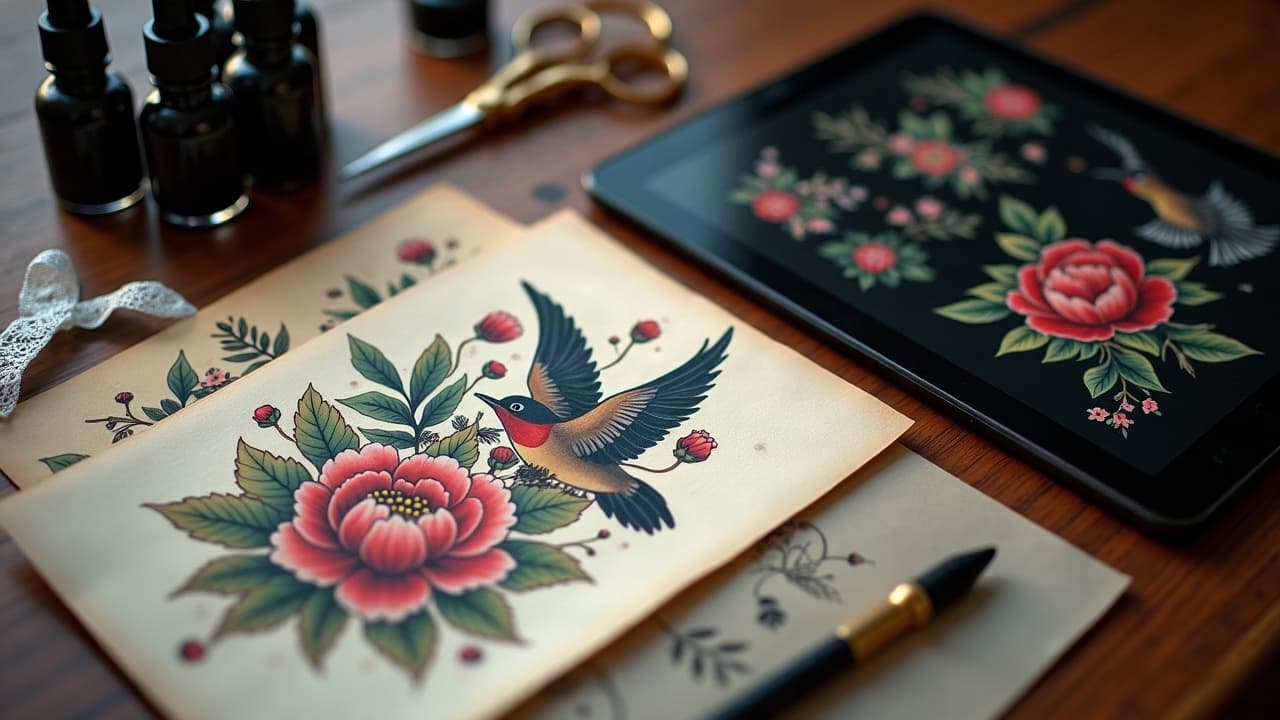
In 1907, Maud Wagner traded a circus act for an apprenticeship and became the first known female tattooer in the United States. A hundred-plus years later, women headline conventions, set style trends, and, in many surveys, are as likely or more likely to be tattooed than men. Recent Pew Research Center findings show roughly 1 in 3 American adults have at least one tattoo, a mass shift that widened space for women to define the medium on their own terms (Pew Research Center national surveys).
From Margins to Momentum: A Short Timeline
Early tattoo history kept women mostly out of shops and on the walls as flash motifs. In the late 19th and early 20th centuries, women appeared as pinups and sailor keepsakes, yet few held machines. Documentation of Maud Wagner and later Jessie Knight in the UK shows scattered exceptions rather than a pipeline. Media of the time treated them as curiosities, not peers (Smithsonian Magazine archives on early American tattooing).
- 1900s–1930s: Carnival circuits and seaside shops, with women tattooed for spectacle. Maud Wagner learns hand-poked technique and starts working clients without electricity.
- 1940s–1950s: Postwar pinup imagery peaks. Jessie Knight gains recognition in Britain, but formal apprenticeships for women remain rare and informal.
- 1960s–1970s: Health crackdowns and city bans restrict the craft. Closed-door apprenticeships make entry even harder for aspiring female artists.
- 1980s–1990s: Legal reopening of cities and first wave of women-owned shops. Kari Barba’s Outer Limits builds a reputation for technical excellence.
- 2000s–2010s: Social media lifts visibility. Kat Von D and televised studios normalize women behind the machine for mainstream audiences.
- 2020s: Women lead in fine-line, ornamental, watercolor, and handpoke revivals, while owning brands and educating new artists.
How Gatekeeping Worked, And How Women Worked Around It
For decades, the entry ticket into tattooing was a closed apprenticeship, often controlled by men and structured around shop subcultures that discouraged outsiders. Add city bans and inconsistent health rules, and the barrier was both cultural and logistical. Women who did make it in usually found a mentor outside normal channels or built a clientele at conventions and guest spots.
The workaround was skill, patience, and proof. Detailed portfolios and reliable healing results traveled fast at a time when forums and then Instagram amplified word of mouth. The shift toward appointment-based studios let artists set their own vibe and safety standards without inheriting someone else’s shop culture. That autonomy is a big reason we see more women crossing from apprentice to owner, and why clients who wanted less macho spaces finally had options.
Pioneers, Icons, and Studio Builders You Should Know
Plenty of artists fit this list. What ties them together is not a single style, but a refusal to be a novelty act. They built shops, codified techniques, or expanded what clients thought tattoos could look like on different bodies.
- Maud Wagner: Early American trailblazer, hand-poking custom work long before household machines.
- Jessie Knight: Among the first prominent female tattooers in Britain, respected for precision under pressure.
- Kari Barba (Outer Limits, CA): Shop owner known for realism and composition, a mentor across generations.
- Roxx (2Spirit Tattoo, SF): Geometric and blackwork specialist, ritual-forward studio culture with thoughtful consent norms.
- Kat Von D (High Voltage, LA): Television visibility normalized women behind the machine for mainstream audiences.
- Grace Neutral (UK): Stick-and-poke advocate and alt-beauty voice pushing style and body autonomy conversations.
- Amanda Wachob (NY): Watercolor pioneer who validated painterly, abstract approaches on skin.
- Whang-od (Philippines): A living link to Kalinga tattoo tradition, modeling matrilineal technique transmission.
How Female Representation Shaped Style
As more women drew the designs and ran the consults, subject matter and surfaces changed. The boom in fine-line, single-needle, and micro-realism is not accidental. These techniques privilege subtlety, composition on smaller canvases, and wearable detail that complements various wardrobes and work settings. They also reward patient line control and aftercare education because micro lines punish sloppy healing.
The same shift happened in ornamental work. Mandala, lace, and ornamental blackwork pieces that follow rib arcs or hip lines reflect a deeper conversation about the body as design space, not just a flat poster. Watercolor and abstract tattooing, widely associated with artists like Amanda Wachob, validated non-outline color play and painterly flow for clients who never saw themselves in flash racks.
This does not mean women only do delicate styles. It means the expansion of who tattoos expanded what tattoos look like. If you want to think through symbolism and identity alongside style, see our cultural meanings guide for guardrails on respectful choices.
Health, Safety, and Agency
Client safety is a cultural value, not a checklist. As women opened studios, many foregrounded consent norms, trauma-aware consults, and meticulous aftercare coaching. That aligns with dermatology guidance. The American Academy of Dermatology underscores risks like contact dermatitis and infections, and the value of vetted aftercare products and clean technique (American Academy of Dermatology guidance). The FDA reminds clients that pigment regulation is uneven, with recalls and contamination alerts surfacing periodically (U.S. FDA tattoo ink safety).
If you want basics, healing is typically 10–14 days to close at the surface, with full settling over 4–6 weeks. Keep it clean, lightly moisturized, and out of pools. Healthline** has plain-language primers that mirror what good studios teach (Healthline on tattoo aftercare basics).
- Aftercare standbys: Bepanthen, Aquaphor, Hustle Butter, Mad Rabbit, and breathable films like Saniderm (non-sponsored examples).
- Studio hygiene: single-use needles and tubes, documented sterilization logs, and sharps disposal all visible to clients.
- Consent-first consults: clear discussion of placement, visibility at work, pain plans, and break policy before you sit.
Representation Outside the West
Female representation in tattooing did not begin on TV. In the Philippines, Whang-od, now over 100 years old, trained generations in hand-tapped Kalinga motifs, reinforcing continuity through grand-niece apprenticeships. In Aotearoa New Zealand, moko kauae chin tattoos worn by Māori women are cultural taonga, carrying genealogy and status. Polynesian, Berber, and Amazigh tattoo histories include women as both bearers and practitioners.
If you are inspired by these traditions, respect protocol. Seek practitioners from within the culture, ask permission, and accept no as an answer. Our guide to tribal vs Western meanings unpacks appropriation risks and ways to honor lineage without copying protected patterns: read it here.
Shifts in Studios, Pricing, and Power
Representation changed who holds the keys. Women opened appointment-only spaces, private studios, and collective shops that prioritize safety, gender inclusivity, and transparency. That shows up in everything from published aftercare PDFs to posted policies on harassment. It also shows up in pricing, which signals value and sets expectations.
Typical hourly rates in major cities land around $150–$400, with day rates at $1,000–$2,000 for complex work. Deposits are standard, usually $100–$300, applied to the final total and nonrefundable inside a set window. Clear contracts protect both parties and reduce ghosting. If your job has visibility rules, see our guide on choosing tattoos for your profession so a neck piece does not cost you twice.
- Ask about redraw fees, and how many revisions are included in the quote before the stencil is set.
- Request a written aftercare plan, plus a touchup policy, often free within 3 months if you follow care.
- For large projects, confirm session length, break timing, and how to manage pain and hydration during long sits.
Empowerment Is Practical, Not Abstract
For many clients, especially women who were policed for how they look, a tattoo is not just rebellion. It is agency over a scar, a story reclaimed, or a promise worn daily. Research on body image and identity consistently notes the role of self-authored appearance in confidence and coping. You can read about reflective practices in our piece on tattoo therapy and emotional healing.
Empowerment is also choosing practicalities that support your goal. If you want a delicate clavicle line for a black-tie dress, durability and sun exposure matter. If you are marking a mastectomy journey, privacy, aftercare film use, and gentle ointments figure heavily. Be specific, and your artist will be too.
Designing With Intention, Trying Before You Book
Start with meaning, then translate it into form. Collect references that express mood, line weight, and placement, not just subject. Call out whether you prefer single-needle or bold line, and if you want color or black and gray. Photographs of your body area in natural light help the artist sketch to scale.
- Shortlist three artists whose healed work matches your goal, not just their highlights.
- Write a 4–6 sentence brief with size in inches, placement, and must-include elements.
- Mock up scale and flow at home with skin-safe marker or a temporary stencil to sanity check curves and visibility.
Digital tools make this part smoother. You can generate concept art and test placements before committing, which helps you communicate with your artist and manage expectations on size and detail. If you are exploring styles, our guide to prompt flexibility shows how to steer the same idea into watercolor, ornamental, or fine-line directions.
Ready to see how your concept reads on your body before you email the studio? Use AI for Tattoo to generate variations, then try placements with the virtual Try-On. Start a design in minutes at Create, preview on skin at Try-On, or browse live style examples in Styles.
Try AI for Tattoo Free