
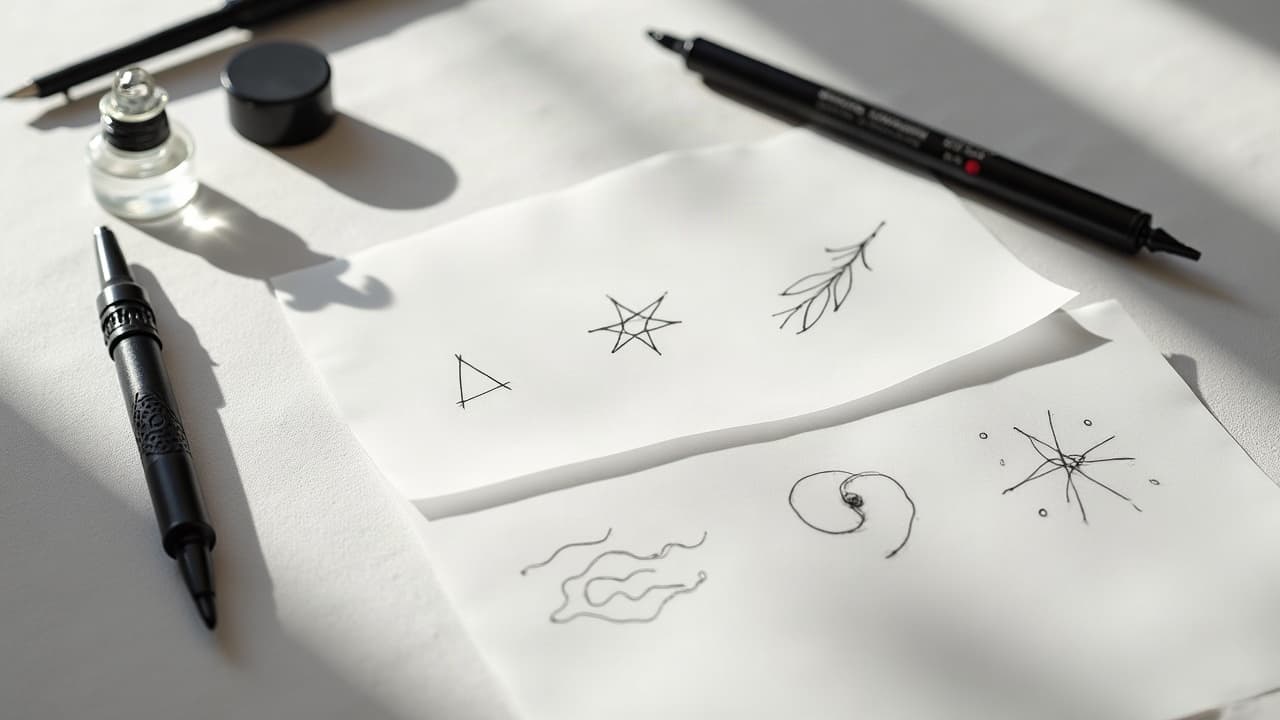
Minimalist tattoos look effortless, but they are engineered. The cleanest small pieces are built on line weight, strategic placement, and negative space. Get those three right and your symbol stays legible, personal, and timeless at arm’s length and across a room.
What Makes a Tattoo Minimalist, Technically Speaking
Minimalism in tattoos is not just tiny art. It is constraint, usually single-needle or 3RL linework, limited shading, and clear silhouettes you can recognize on a quick glance. Most artists keep to black ink for durability, then rely on negative space to imply depth or motion. A minimalist piece should be readable in under one second. If you need to explain it, the design may be carrying too many ideas for the scale.
Three quick tests: shrink your stencil to 1.5 cm on screen, view it at arm’s length, then mirror-flip it. If it stays crisp in all three, the structure is sound. If it falls apart, simplify the interior detail, thicken key lines by 0.1–0.2 mm, or open up spacing.
Why Less Is More, Emotionally and Aesthetically
Minimalist symbols hit fast because the brain loves patterns. A circle for wholeness, a line for direction, a star for guidance. Clean marks are wearable across seasons, jobs, and styles, which is why many people report feeling calmer about commitment with smaller, restrained pieces. If you are using your tattoo for personal processing or closure, simple marks often carry the weight without the noise. For more on the mental health angle, see our tattoo therapy guide.
A practical bonus, minimalist tattoos are easier to dress up or down. A tiny wrist line or ankle dot plays nice with formal wear and still feels intimate on a beach day. The aesthetic restraint also ages gracefully, because there is less detail to blur, and the story remains legible after 10+ years with proper care.
How to Choose a Meaningful Symbol That Endures
Start with the feeling, not the catalog. Name the emotion or change you want to mark, then translate it into shape language. Triangles for momentum, circles for continuity, coordinates for a place that matters, or a single glyph that only your circle understands. When in doubt, tie the symbol to a lived decision date, a place on a map, or a habit you protect daily.
- Archetype shortlist: a triangle for growth, a compass point for direction, a minimal wave for resilience, a semicolon for survival, a tiny laurel for earned wins.
- Personal shorthand: coordinates, initials stacked vertically, a numeric date split by dots, or a single phonetic glyph only you and a few know.
- Nature cues: a single pine for endurance, a crescent for cycles, a line sun for renewal, a mountain outline for overcoming a climb.
- Keep cross-cultural respect in mind. If you are considering script or sacred motifs, study context and meanings. Start with this culture and meaning primer.
Reality check your choice with two filters. First, time-proof it. Would this still matter in 5 years if the context shifts. Second, ambiguity test. The best minimalist symbols carry two readings, private and public, so you never feel overexposed when someone asks what it means.
Placement Strategy, Pain, and Longevity for Small Work
Placement is a performance decision. Skin moves and rubs, sunlight hits unevenly, and minimal lines show wear faster in high friction zones. As a rule, pick calm skin for your first fine line, then graduate to trickier spots once you know how your body heals. If you will be outdoors a lot, plan for sunscreen and shade, since UV fades pigment over time. The American Academy of Dermatology recommends SPF 30+ broad spectrum daily. See their guidance at the American Academy of Dermatology.
- Low motion, solid picks: outer forearm, upper arm, calf. Pain about 3–6/10, fade risk low with sun care, lines stay crisp if sized right.
- Medium motion, plan carefully: wrist crease, ankle bone, shoulder cap. Pain 4–7/10, more rub from sleeves or shoes, consider thicker line weight.
- High motion or thin skin, advanced: fingers, sides of hands, ribs. Pain 7–9/10, frequent touch and bending, consider bolder 3RL over 1RL or accept faster softening.
Line Weight, Size Floors, and Avoiding Blowout
Tiny does not mean microscopic. Skin is not paper, it is textured and alive. Below 1.5–2 cm for a multi-stroke symbol, detail competes with skin texture and natural healing blur. On most clients, I set a floor of 0.8–1.0 mm for key outlines and avoid hairline crosshatching. Fine single-needle can look elegant, but the tradeoff is higher maintenance and tighter placement rules.
Depth and angle control matters. Over-depositing ink can cause blowout, a soft haze where lines spread under the skin. Read more in this Healthline explainer on tattoo blowout. Smart prevention, trained hand, slow stretches, consistent machine speed, and patience during healing when scabs itch at day 4–7. Do not scratch.
Black or Color, What Lasts and Why
For minimalist work, black ink wins most of the time. Carbon-based blacks age predictably and read clearly on all skin tones. Pastels and pale yellows can fade faster, and ultra-thin color lines are more sensitive to sun and friction. If color is essential, choose saturated hues, keep lines slightly thicker, and protect with SPF 30+.
Color choice also intersects with skin safety. Certain pigments, historically some reds, have been linked to higher rates of allergic reactions in the literature. The FDA notes ongoing research into tattoo inks and pigments. Review the FDA information on tattoo inks at the U.S. Food and Drug Administration. If you have a history of contact allergies, discuss ink options with your artist and consider patch testing.
Budgeting and Commissioning a Minimal Design
Even a simple dot has a setup cost. Expect a shop minimum of $80–$150 in most cities, with custom minimalist pieces often landing $120–$300 depending on time, redraws, and placement. Value comes from design clarity and execution, not how many lines are on your skin.
- Budget smart: include consult time, a possible redraw fee, aftercare products, and a 15–25% tip if service and safety were excellent.
- Ask for options: one version at 1RL, another at 3RL, plus a bolder scale. Compare on skin with a stencil before deciding.
- Bring reference, not finished art: show 2–3 symbols you like, describe the feeling and the scale, then let your artist reduce to essentials.
- Preview the flow: wrap the stencil around the limb and check all angles, especially for wrists and ankles that curve in three dimensions.
Aftercare Still Matters for Minimalist Tattoos
Fine lines are small wounds, so treat them seriously. Keep the bandage or Saniderm on as directed, often 3–5 days for second skin, then switch to light moisturization for 2–4 weeks. Wash gently with fragrance-free soap, pat dry, and protect from sun. The Cleveland Clinic outlines infection signs and safe care steps. See the overview at the Cleveland Clinic health site.
- Recommended products for healing, Bepanthen, Aquaphor, Hustle Butter, Mad Rabbit, and Saniderm. These are non-sponsored examples and should be used as directed.
- Typical healing window, surface settle in 7–14 days, deeper remodel over 4–6 weeks. Keep it moisturized, avoid soaking, and skip picking.
- Sun care is non negotiable, daily SPF 30+ broad spectrum, hats or sleeves outside peak sun, as advised by the American Academy of Dermatology.
- Numbing for touch-ups, if needed, discuss TKTX or similar topicals used correctly. Always follow your artist’s guidance.
Evolving a Minimalist Tattoo Over Years
The best minimalist tattoos are expandable. You can add a date tick mark each year, extend a line into a constellation, or connect two symbols with a thin path. Leave breathing room on day one so future pieces can join without crowding. For planning multi piece stories, see our take on layering techniques for symbolic tattoo designs and how to stage work in how to transition from small to large tattoos.
If your minimalist piece becomes a waypoint for a bigger map, consider spacing, balance, and negative space along limbs and torso. Our spatial thinking walkthrough in mapping tattoo journeys shows how small marks can guide later compositions without losing their original clarity.
Health Notes You Should Actually Care About
Minimalist tattoos are not risk free just because they are small. Watch for redness that spreads, heat, or discharge, and contact a clinician if you are concerned. A reliable rundown of skin reactions and sun care appears at the American Academy of Dermatology. Ink safety research and recalls are tracked by the U.S. Food and Drug Administration.
Expect short sessions to feel manageable, especially on low motion placements, but listen to your body. A clean environment, sterile tools, and patient aftercare matter more to outcome than session length. For context on symptoms and timelines, Cleveland Clinic’s editorial content is consistently practical at the Cleveland Clinic health site.
Test your minimalist idea before it is permanent. Use AI for Tattoo to generate clean single-needle concepts from a few words, resize to 1.5–3 cm, and preview placement with our virtual try on. Start in the studio safe zone at Create then see it on your skin with Try On.
Try AI for Tattoo Free