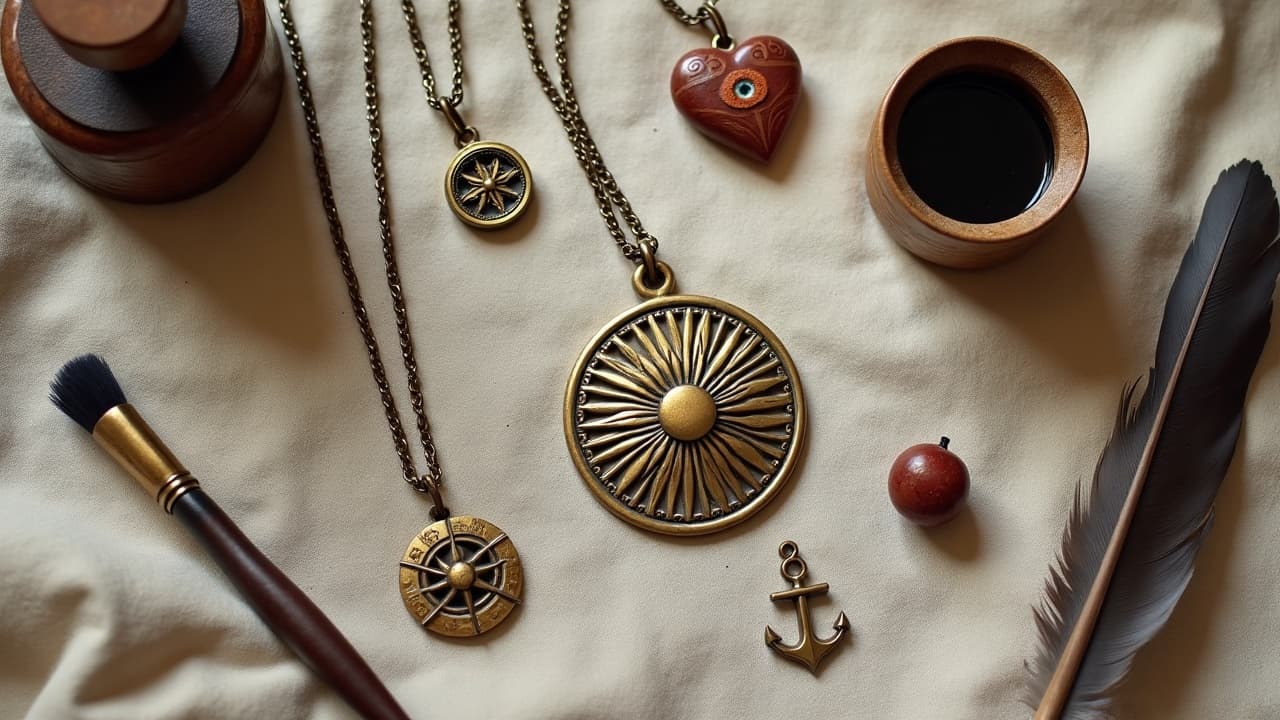
Across continents, the same icons keep showing up on skin: hearts, anchors, suns, eyes. A 2023 Pew Research Center snapshot reports that around 32% of American adults have at least one tattoo, and a big share lean on symbols with instantly readable meaning. Universal motifs work because they compress life facts into lines you can carry. If you plan to combine cultural references, study structure first. Balance, mirroring, and white space are your guardrails. You can crib the basics in our symmetry principles guide, then build a symbol set that reads at a glance.
Heart, Anchor, Arrow: Love, Stability, Direction
The heart is older than Valentine cartoons. From sacred art to folk embroidery, a heart means life-force and attachment. Paired with names, it can drift into cliché, but stripped to a clean outline or stitched line, it still communicates love, vitality, and connection in any language. The anchor is maritime by origin, yet it reads as stability, a promise to hold fast when water gets rough. And a straight arrow means intent, motion, and choosing a line through chaos. Angle it upward for aspiration, backward with fletching for memory, or crossing two for reciprocity. These three play well together. A small trio can sit on a wrist at 3–5/10 pain, or scale up across the forearm at 5–6/10 with soft shading. If you want crisp mini-symbols, ask for single-needle or fine line and keep aftercare simple with breathable film and balm like Saniderm, Bepanthen, Aquaphor, or Hustle Butter (non-sponsored examples).
- Quick reads: heart equals love or life, anchor equals grounding or hope, arrow equals direction or drive. Combine for a micro-narrative that signals steadiness in pursuit of what matters.
- Placements that stay readable: inner wrist, collarbone notch, small sternum cluster, outer forearm. Budget $100–$300 for small linework in most cities, more in top-tier studios.
- Styling cues: keep line weight consistent, avoid cramped spacing, and let each icon breathe. Negative space is key for tiny universal symbols to age legibly.
Suns, Moons, and Stars: Cycles, Balance, Guidance
The sun reads as source, growth, and clock. Across cultures, it maps to clarity, confidence, and the will to act. The moon carries reflection, rhythm, and change, a reminder that phases are part of surviving seasons. Stars are navigation in the literal and figurative sense, a wayfinder when the path is dark. A micro constellation says you choose your bearings rather than wait for a sign. Lean minimal for cosmic symbols so the message stays clear. A sun dot with a thin halo, a crescent with gentle taper, three five-point stars, these stay legible over decades. On the pain spectrum, ribcage crescents can spike to 7–8/10, while outer arm or calf stays in the 3–5/10 band.
- Pairings that work: sun with mountain for resilience, moon with wave for emotional rhythm, star trio trailing an arrow for self-guided progress.
- Finish choices: fine line for delicacy, dotwork halos for glow, soft whip shading for gentle gradients. Keep black or muted palettes for better longevity.
- If you track meaning through pattern, mirror left and right placements to echo cosmic balance. See structural ideas in our symmetry guide.
Snakes and Dragons: Renewal and Power
The snake sheds skin, universally tied to renewal, healing, and cunning. In medicine, the rod of Asclepius coils a serpent to honor knowledge. In folk art, a serpent can also warn of danger kept in check. Coiled around a branch or encircling an ankle, it reads as contained power. Dragons travel even more easily across maps, from guardians of treasure to symbols of wisdom and good fortune. The shared base note is vitality harnessed to purpose. These forms need flow. Wrap them where the body curves, forearm spirals at 5–6/10 or calf wraps at 4–5/10. For clarity, keep heads larger than tails, and map scales with consistent spacing so lines heal clean.
- Meaning accents: ouroboros circle for cycles, blossom in jaws for life after trial, pearl for enlightenment. Keep composition readable from two meters away.
- Line strategy: bold outer contour with lighter internal scales extends lifespan. Fades are inevitable, but clear silhouettes survive the longest.
- If color-sensitive, watch reds and yellows. The American Academy of Dermatology notes red pigments trigger more allergies than other hues, so patch test if prone to reactions (see AAD).
Birds and Wings: Freedom, Soul, Message
Across cultures, birds mark transition. A swallow owes fame to sailors counting miles traveled, yet it reads universally as return and loyalty. Doves map to peace almost everywhere. A simple wing is momentum and mercy, a symbol of the soul in motion. If the goal is freedom without flag-tying to a specific nation or faith, lean abstract wing shapes or neutral species silhouettes. Place birds where they can fly along muscle lines. Shoulder cap to upper arm at 4–6/10 lets feathers lay with deltoid curves. For micro work, a 1.5 to 2 cm outline stays crisp longer than a fully shaded mini.
- Compositions that read: single wing on sternum, pair of swallows at collarbones, tiny dove behind the ear. Keep feather counts low for minis to avoid blur.
- Style options: linework for lightness, dotwork for air, light graywash for softness. Avoid dense filler on small wings to preserve negative space.
- Meaning stacks: wing plus anchor equals freedom with responsibility, bird plus key equals message and access. Sketch combos in our design library before you book.
Eyes and Hands: Protection and Agency
An eye is a watcher. Whether you reference an apotropaic eye, the Eye of Providence, or a minimalist almond with a pupil, the shared reading is awareness and protection. It says I see and I am seen. Hands work the other axis: the hand is agency and craft. A palm can bless, halt, or help. Two hands together often mean pact, solidarity, or making something together. These look best with strong geometry. Keep the eye’s negative spaces clean, anchor with lashes or a tear only if it fits your story. Simple hands need confident finger taper and clear knuckle breaks. Micro-hands blur if over-detailed, so edit hard.
- Placements that suit: forearm for handshake, upper back for watchful eye, small wrist eye for a daily talisman. Pain averages 3–6/10 on these zones.
- Add-ons: a tiny star above the eye for guidance, a thread connecting two hands for bond. Keep line weights consistent to prevent muddy healing.
- If you lean ritual, read contexts first. Our guide to ancient tattooing practices helps you respect source material while using universal forms.
Flowers Across Borders: Lotus, Rose, Chrysanthemum
Flowers are everywhere in tattoo culture because plants carry meaning without a dictionary. A lotus is rebirth from mud to bloom, a symbol of clarity after struggle. A rose is love and thorns together, not just sweetness. A chrysanthemum holds endurance and noble perseverance. The shared core is growth through time, and petals simply let you say it with rhythm and grace. If you want universality, keep botanicals stylized rather than botanist-level literal. Bold petal shapes with limited midtones age better. For micro work, pick three to five petals and a clear center rather than a full bouquet that smears by year five.
- Color notes: muted palettes age kinder. Reds can pop but may trigger sensitivities, especially in old formulations. When in doubt, black and gray is the most universal and stable.
- Placement fit: outer forearm, hip crest, shoulder blade. Pain ranges 4–7/10 depending on size and packing. Budget $200–$600 for palm-size fine line or light color.
- Longevity trick: keep petal edges bolder than interior veins so the silhouette stays readable after a decade.
Skulls, Bones, and Time: Mortality With Meaning
A skull is not only about death. Universally, it says life is finite, choose accordingly. Paired with flowers, it reads carpe diem. With hourglasses or clocks, it underscores focus and urgency. Even if your visual language shifts by region, these anchors don’t need translation. Keep skulls graphic. A stark silhouette with open orbital cavities and a clear jawline holds up better than dental-detail overload. If you go small, simplify teeth to three or four blocks. Healing times for solid black or dense shading run longer than linework. Expect surface healing in around 2–3 weeks and full settling by 4–6 weeks, a timeline echoed by medical providers like the Cleveland Clinic.
- Meaning stacks: skull plus candle equals knowledge with risk, skull plus compass equals wise direction, bone plus flower equals resilience after loss.
- Style picks: heavy blackwork for stark reminders, fine line for modern memento mori. Avoid micro realistic skulls, they soften fast and lose intent.
- Placement: forearm panels keep them public, rib pieces make them private. Pain sits 5–8/10 depending on bone proximity and shading time.
Trees, Mountains, and Waves: Place and Perseverance
Nature symbols cross borders without footnotes. A tree is rooted growth and family, a mountain is endurance and summit, a wave is change that repeats until it shapes stone. You can put a person in any country in front of these and the gist lands. For longevity, simplify contours. A triangle mountain with two snow notches, a single S-curve wave, or a trunk with three main branches can hold meaning without getting fussy. Pair with a tiny sun or moon to set the time of your story.
- Good spots: ankle wave at 3–5/10, forearm tree at 4–6/10, back-of-arm mountain at 3–5/10. Curve designs with muscle lines to avoid warping.
- Add texture with dotwork instead of dense shading. Dot density is adjustable and heals quickly, preserving fine detail on small canvases.
- If you travel often, a micro compass near these symbols ties place to purpose. Keep the N bold to anchor orientation.
Infinity, Shapes, and Numbers: Minimal Codes
Some of the most universal marks are the simplest. The infinity symbol reads as unending commitment or curiosity. Triangles handle balance or change, circles hold unity, and numbers mark milestones that need no translation. Combine modest geometry for a personal equation that still lands with anyone. Minimal symbols reward precision. Clean joins, even proportions, and unbroken lines matter more than fancy shading. Keep scale above 1 cm so skin texture does not swallow the form. If you want pigment, plan with your artist. The U.S. FDA does not pre-approve tattoo pigments and notes variability in inks and potential contaminants, so choose reputable suppliers and studios (see FDA).
- Combos: circle plus dot equals centered self, triangle plus line equals change with boundary, infinity plus arrow equals endless learning with direction.
- Placement: fingers are tempting but blur fastest. Inner forearm or collarbone keeps lines crisp longer at 3–5/10 pain and lower abrasion.
- Line weight: 0.25–0.35 mm heals clean for fine line. Too thin and the skin swallows it, too thick and it reads clunky on minimal marks.
Context, Respect, and Longevity
Universal symbols help you speak broadly, but context still matters. When you borrow visual language tied to a living tradition, learn the story and get consent where appropriate. Reading about ceremony and power in designs can prevent harm and sharpen your work. Start with our primer on tattoos as therapy and meaning for how symbols carry weight under stress. Care and materials shape meaning over time too. Allergic reactions and infections distort linework and can scar. Medical sources like the American Academy of Dermatology and Cleveland Clinic outline risk signs, and the FDA explains that pigments vary and some inks may contain metals or other allergens. Choose studios that disclose ink brands, and follow healing protocols. A simple breathable film for the first 24–72 hours, then gentle wash and light balm, keeps universal symbols crisp for years.
Ready to test how these symbols read on your body, at real scale and placement angles? Use AI for Tattoo to build combos, then preview in seconds. Generate a set in Create, or drop designs onto your skin with the Try On tool. Keep what speaks, edit what doesn’t, and walk into your consult with clarity.
Try AI for Tattoo Free