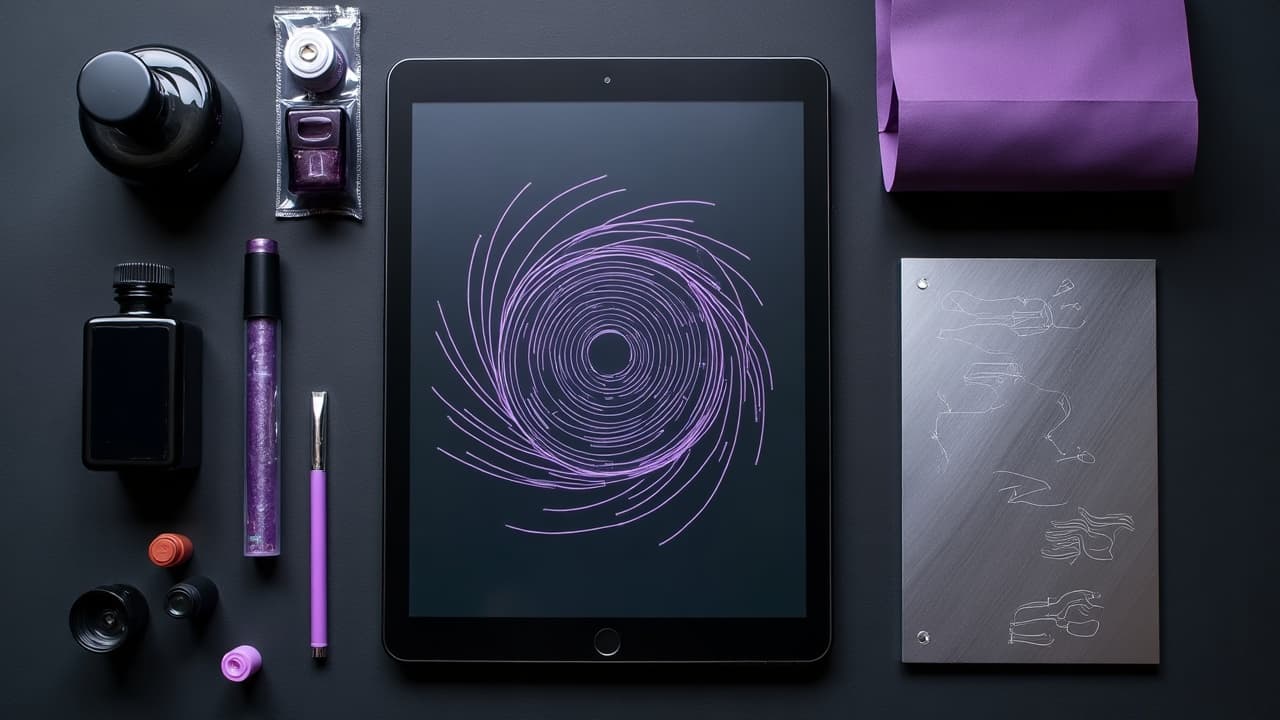
By 2030, the first draft of most custom tattoos will come from an AI co-designer trained to your body, schedule, and references. That will not replace artists, it will speed the sketch phase and widen what is possible. Public comfort with AI is rising every year, as tracked by Pew Research Center, and tattoo tech tends to follow broader creative software trends by 2 to 4 years. The result is a future where human taste, machine iteration, and clean execution merge into faster consults and better-healed pieces.
Prediction 1: Hyper-personalized co-design becomes the default
Today you bring screenshots and a paragraph. By 2030, you will bring a private profile that captures your skin tone, body map, sun exposure, preferred styles, and a few notes about meaning. The AI will synthesize a first pass that fits your exact forearm curvature and leaves room for existing ink. Think co-design, not autopilot. You will still say yes or no, the model simply gets you to the good options faster.
Expect richer control compared to simple style prompts. Designers will blend pose-conditioned models, LoRA style packs, and control nets to place motifs precisely, then export clean vector stencils. Privacy will be table stakes, with opt-in data collection and on-device rendering for sensitive body images. For clients who want tactile references, artists can still rough in markers or iPad sketches with Procreate or Clip Studio Paint (non-sponsored examples) layered over AI drafts.
- Bring a short values brief, three reference images you truly like, and one you dislike, then let the AI produce 4–6 focused directions you and your artist can refine.
- Use body-aware placement tools to preview scale, rotation, and negative space around muscles and joints, especially for forearms, ribs, and calves.
- Lock your privacy settings to store only design metadata, not raw body photos, unless you explicitly consent to secure cloud storage.
Prediction 2: Style engines create new hybrid aesthetics
We already see AI blending traditional, tribal, and abstract references into fresh looks. By 2030, licensed style engines will enable ethically trained models that can generate biomech–watercolor, glitch–batik, or graphite–single-needle hybrids that still read clean on skin. Artists will steer these with custom palettes and line-weight constraints so the output is tattooable, not just pretty on screen. For a baseline on how AI currently interprets trends, see our deep dive on style evolution.
Expect curated LoRA packs and brush presets matched to ink behavior, needle groupings, and healed contrast. Tool vendors that already support tattooers, like Tattoo Smart and Astropad (non-sponsored examples), will likely ship packs tuned for AI-to-stencil workflows. The strongest artists will treat AI like a fast apprentice, not a stylistic crutch.
- Hybrid styles that will thrive: ornamental–biomech, geometric–brushwork, illustrative–blackwork, and flora–cyber motifs with readable silhouettes.
- Constraints that matter: keep line hierarchy, limit mid-tone mush, and prioritize negative space for longevity on medium to dark skin tones.
Prediction 3: Ethical licensing, provenance, and real royalties
The largest shift will be consent. Expect training sets that are opt-in only, with artists signing clear licenses for their portfolios. Provenance tags, like C2PA content credentials, will follow a design from model output to final stencil so shops can show how a concept evolved and who gets paid. That transparency supports fair credit and deters style cloning without permission.
Studios may subscribe to licensed style libraries, and creators could receive 5–15% royalties on designs derived from their packs. That is not a tax on inspiration, it is a trail that honors the human source material. Public sentiment already favors disclosure around AI content according to Pew Research’s work on AI attitudes.
Prediction 4: Safer skin, with AI pre-checks and flagged risks
Safety will be built into design tools. Body photos used for try-on will run through an on-device skin scan that flags moles, scars, and rashes so artists do not place ink over potentially concerning areas. The American Academy of Dermatology advises against tattooing over moles and notes that certain pigments, especially reds, are more likely to trigger allergic reactions. Read more on the AAD site at aad.org.
Expect ink ingredient disclosures to be easier to parse. The U.S. FDA notes that tattoo inks and pigments are not preapproved for injection, and adverse reactions, while uncommon, do occur. The FDA provides consumer safety information at fda.gov. For healing timelines, reputable medical sources like the Cleveland Clinic put the surface-heal window around 2–3 weeks, with deeper maturation continuing beyond that. See their tattoo care guidance at clevelandclinic.org.
Smart aftercare will follow the same path. Expect AI to generate personalized aftercare plans that adapt to placement and skin type, with reminders keyed to your healing stage. Product choices will stay familiar, just better timed, like Saniderm, Bepanthen, Aquaphor, or Hustle Butter (non-sponsored examples). Always follow your artist’s instructions if they differ.
Prediction 5: Mixed reality planning and ultra-accurate try-ons
AR try-on will jump from cute filter to precision tool. Depth-aware cameras and AI body mapping will render designs to your exact limb in real scale, respecting curvature and foreshortening. You will preview line weights, opacities, and wrap across moving joints, then export a session-ready stencil package. Get a taste of this approach with our virtual try-on.
- Live try-ons will simulate aging contrast and fade trajectories, so you can pick bolder lines where needed for longevity.
- Session planning will auto-slice large pieces into 2–4 appointments with estimated pain zones and breaks based on your prior sessions and recovery notes.
- Depth cues will highlight risky distortions on ribs, elbows, or ankles, steering you toward placements that look good now and in 5–10 years.
Studios will run on AI pipelines, not folders
Studios will replace ad hoc Dropbox folders with pipeline tools. Expect versioned design boards, client CRM, consent forms, pigment logs, and sterilization checklists unified in one dashboard. Automated pre-consults will collect body scans and references, then generate smart briefs that reduce back-and-forth. Scheduling integrates with design status so no one books a session before a stencil is approved.
Monthly software costs will look like other creative stacks, roughly $40–$150 per user, depending on storage and licensing tiers. Artists will still sketch on iPad or desktop using Procreate, Photoshop, or Affinity Photo, with bridge plugins to the AI toolchain. For payments and bookings, expect continued use of Square, Stripe, or Fresha alongside tattoo-specific platforms (non-sponsored examples).
Money in 2030: what clients will actually pay for
AI will compress grunt work, not artistry. Studios will unbundle design from execution with transparent pricing. Expect a design package fee credited toward your appointment if you proceed, plus the usual hourly or day rate for tattooing. The package buys focused iteration, accurate try-ons, and a locked-in stencil.
Baseline numbers will vary by city, but a practical range looks like this: $50–$200 for an AI-assisted concept package, $150–$300/hour for tattooing, or $1,200–$2,000 day rates for large work. You are paying for human judgment, clean lines, and healed results. That part never automates.
Guardrails: consent, data, and not copying living artists
Ethical AI in tattooing means consent at capture and consent at training time. Body photos used for try-on should process locally when possible, with explicit opt‑in for cloud storage. Style engines must honor licensed training and make provenance of outputs obvious to both client and artist. Public support for transparency is clear from ongoing coverage at Pew Research Center.
Health guardrails matter too. The Mayo Clinic and Healthline maintain general tattoo care advice, reinforcing that infection risks, allergies, and keloid scarring are real considerations. Check them at mayoclinic.org and healthline.com. Meanwhile, the FDA continues to monitor pigment safety. As models get smarter, the best shops will get stricter about informed consent, rights clearance, and clear documentation.
How to start benefiting now
You do not have to wait for 2030. You can already co-design and preview with useful accuracy, then bring a polished brief to your artist. If you are new to prompts, start with our prompt crafting guide and keep your language plain and specific. If you want to understand where AI styles come from, read our style evolution primer.
- Generate 3 concepts with clear constraints on size, placement, and must‑include elements using AI for Tattoo’s creator.
- Try each design on your body with our depth-aware try‑on to check wrap and scale, then export your favorite for a consult.
- Package your references, preferred line weights, and any allergy notes into a single PDF or link, and email ahead so your artist can prep efficiently.
- Study how geometric planning works with our mathematics of ink guide to better judge what will age cleanly.
Ready to see the future show up on your skin today? Generate a design in minutes with AI for Tattoo, then preview realistic placement with our virtual try‑on. Bring a tight brief to your artist and spend your session on confident execution, not guesswork.
Try AI for Tattoo Free