
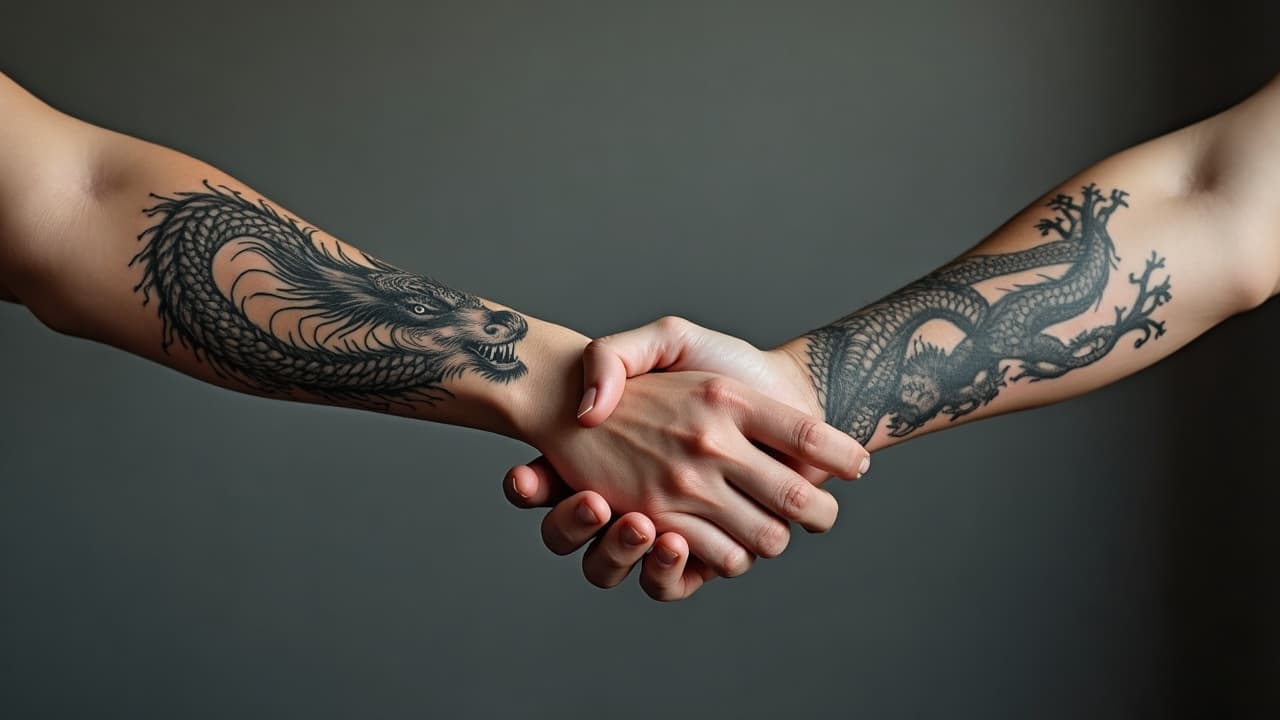
In most studios, dragons, phoenixes, and kitsune are perennial top requests because they carry built‑in story and movement. The tattoos that age well have more than cool linework, they translate myth into a clear focal, cohesive flow, and personal symbolism that fits the body like it was always there.
Pick the right creature, tie it to your story
Before sketching horns or tails, lock your why. A mythic tattoo lands when the creature mirrors a chapter of your life, not just a trend. Start with two prompts, one value you want to honor and one life scene that proves it. From there, match symbolism to an actual visual language so your piece communicates without a caption.
- Dragon, power through discipline. Works in Japanese, neo‑traditional, or black and grey realism. Pair with clouds or peonies to soften aggression and frame the head as the focal.
- Phoenix, rebirth and resilience. Best with warm palettes and feather texture. Show ascent with upward flow lines and light at the crown for a hopeful read.
- Kitsune, cunning and protection in Shinto lore. Emphasize multiple tails, masks, or torii gates. Fine line plus spot color on eyes keeps it sly, not cartoonish.
- Kirin, benevolent strength. Combine scaled belly and deer-like legs. Reads well in Irezumi with wind bars, or ornamental blackwork with filigree.
- Leviathan or Jörmungandr, chaos and cycles. Use ouroboros layout around joints, or a wrapping sleeve to suggest infinity without text.
- Griffin, guardianship. Balance avian wings and feline musculature. Works as a chestpiece where the sternum becomes the keel.
If your heritage is part of the motivation, research beyond Pinterest. Encyclopedic summaries like Britannica help verify origins and typical attributes so you do not mix unrelated myths by accident. Cross check design intent with your artist, then choose one dominant symbol and two supporting motifs to avoid visual noise.
Choose a style that carries the myth, not just the trend
Style decides how your creature reads at 3 meters, not just in selfies. Irezumi excels at bold silhouettes and layered backgrounds, perfect for dragons or phoenixes that need motion. Neo‑traditional gives plush forms, thick‑to‑thin lines, and muted jewel tones, ideal for griffins or kirin. Blackwork with stippling lends sacred, museum energy for runic creatures. Realism can be stunning for dragon scales or wet serpents, but it needs big real estate and maintenance to keep contrast crisp.
If you are designing a multi‑piece collection, think system first. Map a shared line weight, value range, and background language so new additions lock in without clashing. Our piece on cohesive sets, tattoo design flow, shows how to plan a toolkit for repeatable choices that still feel personal.
Composition that makes fantasy read fast
Creatures with wings, tails, and horns get busy fast. Good composition simplifies. Build around a single focal, usually the face or the heart of the action, then arrange supporting shapes to feed attention back to it. Keep at least 15–25 percent negative space so scales and feathers breathe instead of turning to static.
- Use an S‑curve or C‑curve through the spine or tail to echo body flow, especially along ribs, thigh, or forearm.
- Set focal hierarchy, head at highest contrast, mid body at mid contrast, tail at soft edges. It guides the eye without arrows.
- Crop with intention, cut tails or wings behind foreground clouds, smoke, or stones to imply depth without micro detail.
- Respect joints, do not bend eyes or beaks across elbows or knees. Bridge with background wind bars or water waves instead.
- Test scale, print at 100 percent and tape on. From 2 meters the face should still read, if not, simplify or enlarge.
- Study our structure primer on balance and anchors in composition essentials.
Color, texture, and light that sell the otherworld
Fantasy dies without believable light. Pick a single light source and honor it across every feather and scale, bright on the crown, deep in the fold. Reserve pure white highlights for wet eyes, teeth, and the sharpest edges, otherwise your contrast flattens after healing. If you are mainly blackwork, one spot color on eyes, flames, or a mask can telegraph magic without repainting your wardrobe.
Palettes that work across skin tones are deliberate. Warm phoenix sets love vermilion to gold, cool dragons crush with teal to indigo, earthbound kitsune hold with rust to bone. For a quick primer on contrast choices that last, see our guide on contrast and spot color. Build texture with crosshatch, whip shading, and pepper shading, then hold back in low light zones to keep a readable silhouette.
Place the myth where it can move
Body placement is not a canvas swap, it is choreography. Put upward creatures like phoenixes on calves, outer arms, or backs where a natural rise exists. Wrapping serpents or ouroboros thrive on forearms, thighs, or around shoulders where circles can close. Guarding griffins feel right on chest or upper back, flanking the sternum or spine as an anchor.
Plan for real-world constraints. Ribs and sternum are 7–9/10 on most pain scales, inner bicep and calf sit around 4–6/10, hands and throat spike at 8–10/10. Budgets differ too, a small blackwork kitsune can be $300–$600, while a color dragon backpiece often runs $3,500–$8,000 over 3–6 sessions. These are averages, ask for a consult with references and printouts so your artist can price accurately.
Cultural respect and accuracy matter
Myth is not generic. A Japanese ryū is not the same as a Chinese long, and a Polynesian mana guardian uses specific glyphs, not guesswork. If you are drawing from living traditions, collaborate or at minimum verify meanings with reliable sources like Britannica. For Polynesian elements, read our primer on motifs and context in the Polynesian symbolism guide.
When in doubt, honor structure without lifting sacred specifics. For example, echo wind bars, waves, or peonies instead of copying deity masks. If your family has ties to the culture, include that in your brief. If not, be transparent and considerate. Strong design does not require borrowing what you do not fully understand.
Skin science that keeps fantasy crisp
Mythic pieces live on skin that changes. Expect some softening as collagen remodels and pigment settles. Good aftercare increases clarity. Use fragrance‑free cleansers, then a thin layer of Aquaphor, Bepanthen, or Hustle Butter for the first 3–5 days, or choose Saniderm style films if your artist approves (non‑sponsored examples). The American Academy of Dermatology notes that sun is a primary fade driver, so daily SPF 30+ after healing is not optional. See the AAD for baseline tattoo care at aad.org.
Some people react to pigments or adhesives. Resources like Healthline summarize common ink allergy signs, redness, itch, and raised lines that persist beyond normal healing. If you have a history of skin sensitivity, patch testing and conservative palettes help. For ink composition and safety updates, check the U.S. FDA tattoo resources at fda.gov. Government guidance evolves, and reputable studios already align with these standards.
Work with references and AI without losing soul
Collect references by role. Anatomy shots for wings and claws, fabric and smoke for motion, historical prints for iconography. Note what each reference is doing, lighting, pose, texture, not just the vibe. Two or three killer references beat thirty average ones. If you want a face in the creature, use controlled prompts and angle matches so light is consistent. Our piece on AI tattoo prompts for portraits covers angle and lens language that transfers well to skin.
AI is strong at iterations. Generate multiple wing spreads, scale densities, or tail curls, then comp by hand to protect flow and line weight. Share a clear brief, one-paragraph story, dominant symbol, style, palette, and placement. For tool collaboration, see best AI tattoo tools for artists so you can preview options with your artist before stencil day.
Timeline, pain, and budget planning for big myth builds
Large fantasy pieces stretch across months. A half sleeve dragon usually takes 2–4 sessions, a backpiece often takes 5–8, with 10–14 days between sits for surface healing and 4–6 weeks for deeper settling. The Cleveland Clinic notes that general wound healing follows staged timelines, inflammation to remodeling, which aligns with how tattoos calm and sharpen over weeks. See Cleveland Clinic for skin healing overviews.
Pain is manageable with planning. Many sit comfortably at 4–6/10, spikes happen near ribs, spine, armpit, and ditch at 7–9/10. Budget compounds with time, expect $150–$250 per hour in many cities, higher for senior specialists. Break payments by milestone, linework pass, color blocking, texture and highlights, so you can pause without losing cohesion. Keep a shared board of healed photos to track contrast and adjust strategy session by session.
Ready to see your dragon curve with your forearm or your phoenix lift along your back before you book time? Use AI for Tattoo to generate variants that match your style and try them on at scale. Iterate on flow, color, and placement in minutes, then walk into your consult with a focused brief and a design that already reads strong.
Try AI for Tattoo Free