
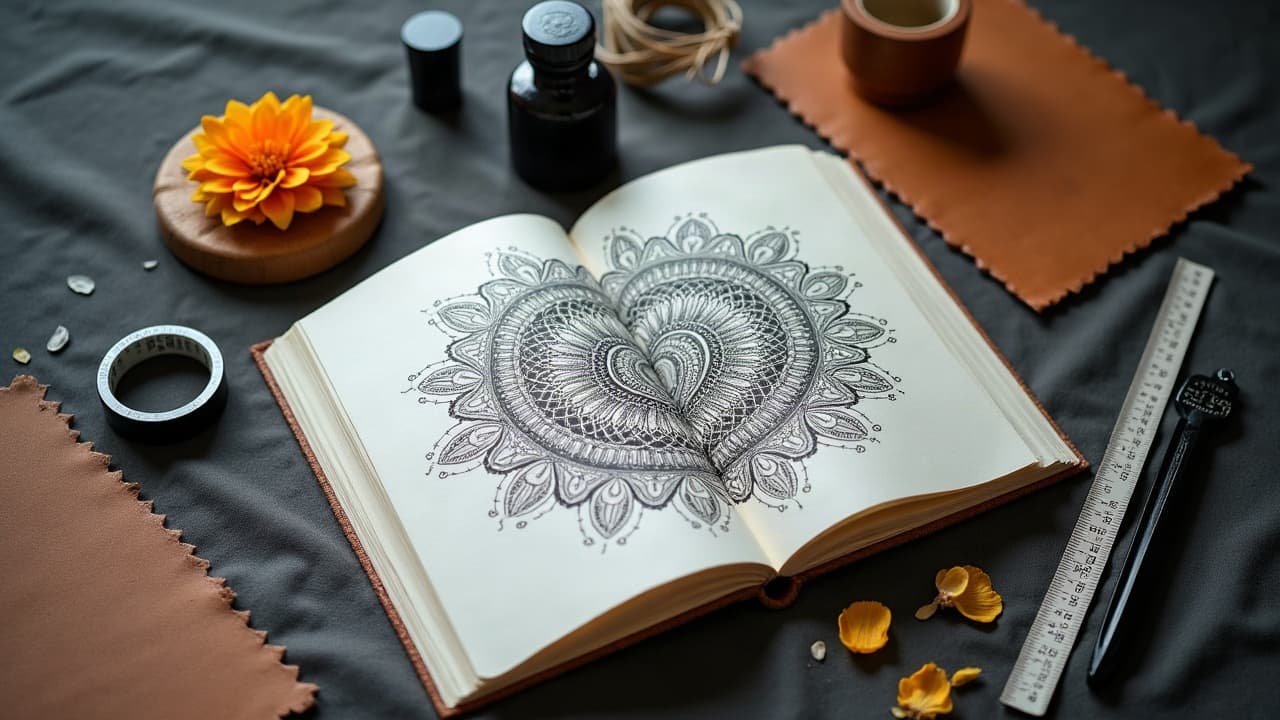
A true mandala holds radial symmetry around a precise center. If that center drifts even 1 mm, your eye reads it instantly. On living skin that flexes and breathes, keeping the geometry clean takes planning and respect for where mandalas come from. Across Buddhist and Hindu traditions the mandala maps the cosmos and the self, a blueprint for focus and impermanence. When you wear one, you are choosing a design with centuries of ritual use. This guide decodes meaning without gatekeeping, then shows how to translate that symbolism into tattoo design styles that suit your body, pain tolerance, and budget.
What a Mandala Is, Historically, Not Just Aesthetic
In Sanskrit, mandala means circle, but in practice it is a structured diagram used for meditation and teaching. Tibetan Buddhist sand mandalas are built grain by grain then swept away, a lesson in impermanence and non-attachment. In Hindu art, yantras such as the Sri Yantra use interlocking triangles to symbolize cosmic union and balance. Indigenous sand paintings in the American Southwest and Islamic geometric art share visual kinship with mandalas, though their theologies differ. Knowing the roots helps you avoid flattening them into generic decor. For background that is not filtered through tattoo culture, read the encyclopedic overviews from Encyclopaedia Britannica. If you are navigating safety, risks, or aftercare facts, keep a bookmark for the American Academy of Dermatology and the U.S. FDA on tattoo inks and reactions.
Core Meanings People Assign To Mandala Tattoos
Meaning is personal, but certain interpretations show up again and again in the chair. The circular form invites the wearer to treat the piece as a focal point for breath, attention, and self-ordering. Symmetry becomes a reminder that balance is practiced, not granted. Petal counts and armatures can be tailored to what you want the piece to hold, visually and emotionally.
- Center point as self: a bindu or dot in the middle to represent awareness, then rings that signify growth, roles, or seasons orbiting that core.
- Four- or eight-fold symmetry for balance: cardinal directions, elements, or life domains. Even counts read calmer than odd counts on most bodies.
- Lotus petals for resilience: lotus rises from mud and blooms clean. Great for recovery arcs or sobriety milestones without literal text.
- Interlocking triangles for union: upward-fire with downward-water, a nod to the Sri Yantra lineage without depicting deities if you prefer secular.
- Latticed borders as protection: pattern as a symbolic perimeter, useful on sternum or spine where people want grounding and coverage.
Design Styles That Carry Mandala Symbolism Today
Tattooing gives the mandala new dialects while keeping its grammar. You can stay fully ornamental or fuse it with flora, fauna, or script. A few families dominate studios because they age well on skin and photograph cleanly.
- Dotwork and blackwork: stippled shading for velvet gradients, with solid black fills to anchor borders. Heals flatter and lasts in sun better than light color.
- Fine-line lace: micro-line petals, filigree, and white highlights. Gorgeous on small placements, but needs meticulous aftercare to keep line weight crisp.
- Sacred geometry fusion: hexagons, Metatron’s Cube, and Sri Yantra layering. Works for larger backs or chests where the grid can breathe.
- Botanical overlays: ferns, peonies, or lotus weaving through the rings. Great middle ground if you want organic softness within strict symmetry.
- Color-work: muted palettes or jewel tones. Beautiful on medium to deep skin when artists choose opaque pigments with high contrast, not pastels.
Placement, Scale, and Pain Reality Check
Mandala geometry needs room. Small is possible, but under 6 to 8 cm you lose petal definition. Flat or gently curved canvases are friendliest to symmetry. Pain is part anatomy, part session length. Expect multiple passes for lining, stipple, and cleanup, which compounds sensation.
- Least painful and most stable: upper arm, outer thigh, calf. Typical pain level 3 to 5 out of 10, 1-session builds up to 2–3 hours.
- Moderate: forearm, back, flank. Pain 4 to 6 out of 10. Curvature demands stencil precision. Plan breaks every 45–60 minutes.
- Spice level: sternum, ribs, spine, knee cap. Pain 7 to 9 out of 10 with bony contact and vibration. Consider multi-session builds.
- Hands and fingers: high movement and sun. Beautiful but high-maintenance. Expect faster fade and potential blowouts from tight skin.
- Scale guidance: a balanced half-sleeve medallion usually wants 14 to 18 cm diameter to keep inner rings legible.
Cultural Respect: Getting Meaningful Without Misusing
You do not need to depict deities to honor the structure of a mandala. Many clients choose secular symbolism that borrows geometry, not religious iconography. If you are considering specific Buddhist or Hindu motifs, make space for research and conversation. When in doubt, keep the form, not the liturgy, and be explicit about your intent when briefing your artist.
- If you are not a practitioner, avoid sacred mantras or deity faces. Choose lotus, petal counts, and ring architecture that speak to your story.
- Use source materials respectfully. Museum catalogues and Britannica’s mandala entries beat Pinterest mashups.
- Credit lineages in your caption if posting. Context keeps designs from reading like trend-chasing.
- Ask your artist how they handle cultural motifs. A quick chat sets scope, especially for Sri Yantra or temple iconography.
- Prefer secular guides like compass roses or nature motifs if you want zero religious baggage yet similar center-out flow.
Build and Aftercare: How Mandalas Stay Sharp
Crisp mandalas come from clean stencils and controlled depth. Many artists map the center with crosshair dots, then lock 4-way or 8-way symmetry before adding secondary rings. Dotwork gradients are layered lightly to avoid muddying edges. I favor 3RL to 7RL for lines, bugpin mags for whisper shading, and I slow the hand on tight radii to avoid wobbles. Healing affects symmetry the same way application does. Large mandalas weep more plasma, so thin coats of Aquaphor, Bepanthen, or Hustle Butter keep it supple without choking pores. A breathable barrier like Saniderm for 3 to 5 days helps with friction zones. Most tattoos surface-heal in 10 to 14 days and settle in 4 to 6 weeks, timelines supported by the Cleveland Clinic. The AAD notes tattoo reactions are uncommon but real, especially with certain pigments, so watch for raised or itchy areas and consult a pro if anything persists beyond a couple of weeks (American Academy of Dermatology). Ink safety is evolving. The FDA provides consumer guidance on pigments and recalls, useful if you have sensitivities or plan travel tattoos in regions with different regulations (U.S. Food and Drug Administration). When using numbing creams like TKTX, patch test 24 hours prior and avoid slathering multiple layers, which can macerate skin and blur lines.
Time, Budget, and Session Strategy
Symmetry work trades speed for accuracy. A palm-size mandala often takes 2 to 4 hours, while a sternum or back medallion can span 6 to 10 hours over two sittings. In most North American cities, expect $300 to $800 for small to medium, $900 to $1,800 for large multi-session pieces, with a $100 to $300 deposit. Adding filigree or secondary rings pushes time and cost. If you are mapping a sleeve, factor how surrounding motifs will key into the mandala’s center-lines so future additions do not fight the geometry. For first-timers, bookmark our planning primer, tattoo budget tips, to avoid scope creep.
Contemporary Takes and Artists to Study
Look at how top studios balance math with movement. Chaim Machlev blends mandalas into full-body linework that flows with muscle chains. Roxx at 2Spirit Tattoo anchors powerful blackwork medallions with negative space. Thomas Hooper and Kenji Alucky show how dense dotwork reads dimensional without gradients of gray wash everywhere. Dillon Forte demonstrates sacred geometry that stays wearable, placing grids where the body naturally articulates. Studying full portfolios shows what ages well and what only photographs well the day it is made.
Briefing Your Artist or AI: From Idea To Symmetry
Good briefs are specific but flexible. Share why the mandala matters, your must-keep motifs, and what you are open to changing. If you use design tools, control for petal counts, line weights, and center alignment before you fall in love with a mockup. Then let your artist adapt to skin movement and placement, which no flat render fully predicts. For iterative concepting, skim our prompt iteration guide and explore style families in blackwork, dotwork, and lace under Styles so your references speak the same visual language.
- State symmetry preference: 4-fold, 6-fold, or 8-fold. This dictates petal math and ring counts.
- Call line weight in numbers: outer ring 0.35–0.45 mm, inner detail 0.25–0.30 mm equivalents.
- Define contrast: pure blackwork vs black plus a single accent hue for longevity.
- Mark no-go iconography if you want secular geometry only, especially around mantras or deity imagery.
- Share placement photos. Circles warp near joints. Your artist will test-stencil and nudge the center point to compensate.
Why Mandalas Endure In Modern Tattoo Culture
Mandalas condense a big human need into small circles, the need to make sense. They are introspective without being literal, graphic without screaming for attention, and adaptable across bodies and tones. With high-contrast blackwork, a measured size, and realistic session planning, they also age better than many trends. Tattoos are more common than ever, with about one third of U.S. adults reporting at least one piece according to the Pew Research Center. That mainstreaming makes cultural sensitivity more important, not less. Choose structure over stereotype, and your mandala will read as intentional, not ornamental wallpaper. For color choices and layering, see our primer on color layering techniques to keep hues clean around geometric edges.
Test how a mandala sits on your body before you book. Use AI for Tattoo to generate geometry with your preferred petal counts, then try it on your exact placement. Start with a few blackwork and dotwork variants at Create, preview them on skin at Try On, and carry the best mockups to your consult.
Try AI for Tattoo Free