
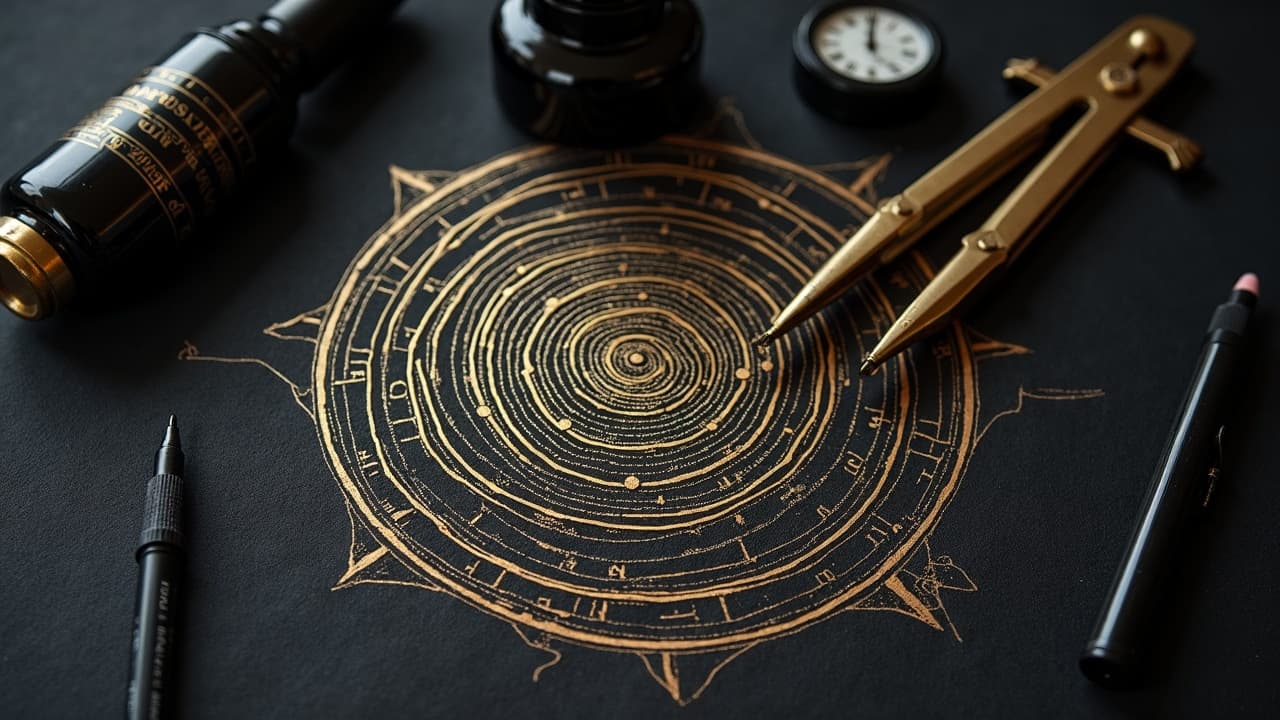
Geometric tattoos succeed because precision sells the illusion. A circle that drifts 2 degrees or a hex that is 2 mm off can make the whole piece feel soft. The upside is huge, though, because well‑planned symmetry, ratios, and negative space create designs that read from 6 feet away and still reward close inspection. With symbolic geometry you are not just drawing shapes, you are encoding meaning with proportion, repetition, and balance that the eye instinctively trusts.
What symbolic geometry actually means in tattooing
Symbolic geometry is the practice of using mathematical patterns and shapes to carry ideas, not just decorate skin. A hexagon might nod to cooperation and structure via the honeycomb, a Fibonacci spiral to growth that feels organic rather than explosive, a mandala to centering and ritual. The shapes are not random, they are choices that echo beliefs, life phases, or values. If you pick geometry for surface aesthetics only, the piece can look cold. If you map symbols to your story, the pattern gains emotional weight and becomes resilient to trend cycles.
In tattooing, geometry has to negotiate living anatomy. Skin stretches, muscles flex, and joints bend. So the geometry that looks perfect on paper will distort on a calf or ribcage unless you plan for movement. That is why strong axes, registration points, and wrap lines matter as much as the pattern itself. If you are new to motif selection, review our composition guide to see how visual hierarchy and symbolism support each other.
The core principles that make geometric tattoos read
Before you pick a motif, lock down the structural rules that determine clarity at a glance. The following principles act like guardrails so the design stays legible on body curves and over time. Keep them visible during sketching, stencil prep, and linework.
- Proportion that feels right: the golden ratio (≈1.618) and rule of thirds are reliable if you need fast balance without overthinking every angle.
- Choose your symmetry type on purpose: reflective (left-right), rotational (0–360 degrees), or translational (tiling). Commit to one primary symmetry to avoid visual noise.
- Respect tessellation fit: hexagons and triangles lock with minimal gaps. Pentagons fight tiling unless you accept intentional breaks or use a Penrose approach.
- Build radial balance around a stable center: for mandalas, anchor to the sternum, navel, or patella to reduce drift when the body moves.
- Prioritize negative space as a shape, not leftover. Thick lines next to air read bolder than adding more lines.
Line weight, negative space, and how skin changes the math
Ink spreads microscopically as it heals, which is why clean geometry relies on line weight and spacing rather than extreme micro-detail. Thin single-needle looks crisp on day one, but if you cram lines 0.5–1 mm apart, they can close up by year two. Use 3RL or 5RL for primary geometry, 9RL if the piece is meant to read across the room, and reserve single-needle for accents. For gradients inside patterns, dotwork and whip shading give control without flooding edges.
Placement matters for longevity. Areas with frequent motion, like the wrist crease or ankle flex, are less forgiving to tight interlines. Negative space buffers of 1.5–2 mm help keep shapes distinct through swelling and minor blowouts. Ink migration, often called a blowout, happens when the needle goes too deep or the skin is overworked. For a plain‑English overview of causes and fixes, see Healthline’s tattoo care resources.
A pattern vocabulary: from Flower of Life to Penrose tilings
You do not need to be a mathematician to use symbolic geometry well, but it helps to pick from a known vocabulary so your choices are intentional. Research the origin of a motif before wearing it, especially designs tied to living traditions. If you want a wider cultural lens on symbols and respect, read our cross-cultural symbols guide.
- Flower of Life: interlocking circles that suggest interconnectedness and cycles. Works well as a chest, back, or forearm panel with radial alignment.
- Metatron’s Cube: a map of Platonic solids inside a circle, often read as order in complexity. Looks best with bold outer rings and lighter internal lines.
- Sri Yantra: interlaced triangles representing cosmic union and focus. Requires precise registration points to keep intersections from muddling.
- Penrose tiling: aperiodic kites and darts, great for sleeves when you want pattern without obvious repeats. Keep a 2–3 mm cadence in spacing for readability.
- Fibonacci spiral: a quarter-arc sequence that signals organic growth. Ideal for rib or calf where you can scale squares progressively.
Placement mapping: wrapping geometry to living anatomy
Geometry loves flat planes, the body has few of them. Great placements honor the site’s natural axes and movement. Think like a tailor. If you anchor geometry to bone landmarks and let patterns break at flex points, the tattoo stays crisp when you move. A few practical maps that work repeatedly are below.
- Forearm wrap: use the ulna as a longitudinal axis. Start patterns 10–15 mm off the wrist crease and finish below the cubital fossa to avoid distortion when flexing.
- Chest panel: center radial pieces on the sternum notch or between nipples. Mirror left-right only if both sides have similar mass, otherwise choose rotational symmetry.
- Back diamond: frame a mandala or hex grid inside a scapular-to-L5 diamond. Keep outer lines heavier so the spine’s movement does not steal attention.
- Calf spiral: run a Fibonacci arc from mid‑Achilles to the lateral head of the gastrocnemius for motion that reads while walking.
- Hand plate: if you must, treat the metacarpals as rails and simplify to bold blackwork, since fine geometry ages faster on high-wear skin.
Turn meaning into a brief: translating intent to math
A clean, symbolic piece starts with a tight brief. Write what the tattoo has to say in one sentence. Then translate that sentence into structure, symmetry, and ratio. During your consult, share a short list of non-negotiables and a longer list of flex items so your artist can compose within constraints. If you are prepping for a multi-session build, skim our consultation checklist by style to make the first meeting count.
- “Growth after chaos” could be Fibonacci spirals expanding out of broken triangles, with line weight shifting from thin to bold.
- “Boundaries and focus” could be a Sri Yantra with heavy outer rings and negative space shielding the central bindu.
- “Community and craft” could be a hex tessellation that transitions into honeycomb with one cell open, a nod to ongoing work.
- “Pilgrimage” could be a mandala compass, cardinal points marked by small dots, plus dotwork shading to imply terrain.
- “Order from randomness” could be Penrose tiles seeded from a single keystone, implying pattern without predictable repeats.
Execution toolkit: needles, inks, stencils, and aftercare
Geometry rewards patience and the right kit. For line architecture, a tuned rotary with a 3RL or 5RL creates stable lines without chewing tissue. Keep your needle depth consistent, float the tip, and breathe with the client when crossing bony landmarks. For setup, use Stencil Stuff or Electrum to lock a sharp transfer, then reinforce critical axes with skin-safe markers once the stencil sets. For fills, dotwork with a 5RL or small mag and slow hand speed builds gradients without fuzzing the edges. Named non-sponsored supplies artists rely on include Dynamic Black, Eternal Ink, World Famous Ink, Panthera, Stencil Stuff, and Electrum (non-sponsored examples).
A quick health note matters here. Some pigments, especially certain reds, are more associated with allergic reactions. The American Academy of Dermatology outlines common tattoo risks like rashes and keloids, a good read if you have sensitive skin. Ink ingredients are not FDA approved for injection the same way drugs are, and the U.S. FDA has ongoing guidance about tattoo inks and color additives. If a client reports prior reactions, patch-test with diluted pigment and consider blackwork geometry and dot shading to avoid heavy color loads. For aftercare that preserves crisp lines, film dressings like Saniderm or SecondSkin, then light hydrators such as Bepanthen, Aquaphor, Hustle Butter, or Mad Rabbit work well when used correctly (non-sponsored examples). For sun, broad-spectrum SPF 30+ helps prevent fade, and the Cleveland Clinic consistently flags UV exposure as a driver of skin and pigment changes.
Color strategy: blackwork, contrast, and selective accents
Most geometric tattoos lean black and grey because contrast is the cleanest language for edges. If you add color, do it sparingly and structurally, for example, a single complementary accent inside a radial band or a muted gradient behind a lattice. Thin color outlines tend to fuzz faster than bold black lines. If you want luminosity without neon, choose mid-saturation hues and let negative space be your highlight. White ink lines can fade to beige quickly on many skin tones, so treat them as a bonus, not the architecture. For a conservative take that ages well, lock the skeleton with bold blackwork, use dotwork for depth, then deploy color as a second read.
Budget, timeline, and session math for clean geometry
Complex geometry costs time because setup and alignment are half the job. Expect $300–$1,200 for a single-session forearm panel with moderate detail, and $1,500–$4,500 for a multi-session half sleeve depending on city, artist pedigree, and fill technique. Plan sessions around your healing so axes stay true and you do not chase swelling. Typical top-layer healing is 10–14 days, but lines settle and soften over 4–8 weeks. That is when a smart artist schedules the refinement pass, to crisp intersections and add micro-shading where the skin has told the truth. For high-traffic spots or color-heavy accents, pad extra time, skin is a variable medium. For prevalence context, around one-third of adults in the U.S. report at least one tattoo, according to the Pew Research Center, so reputable studios book out weeks to months in advance.
If you are on a tight budget, scale strategically. A bold 7–9 inch blackwork mandala with clean negative space often lands stronger than a smaller, hyper-detailed maze that collapses at 2 feet. You can always bolt on tessellated panels or Penrose sleeves later, the vocabulary is modular. For more planning ideas that respect timelines and commitment, see our first sleeve planning guide.
Ready to blueprint your own geometry and see it on your body before you book? Use AI for Tattoo to generate mandalas, hex grids, and Fibonacci layouts with custom meaning, then try them on live or browse styles in our gallery. Prefer to start from text? Spin up a brief in minutes inside Create and iterate until the pattern and placement click.
Try AI for Tattoo Free