
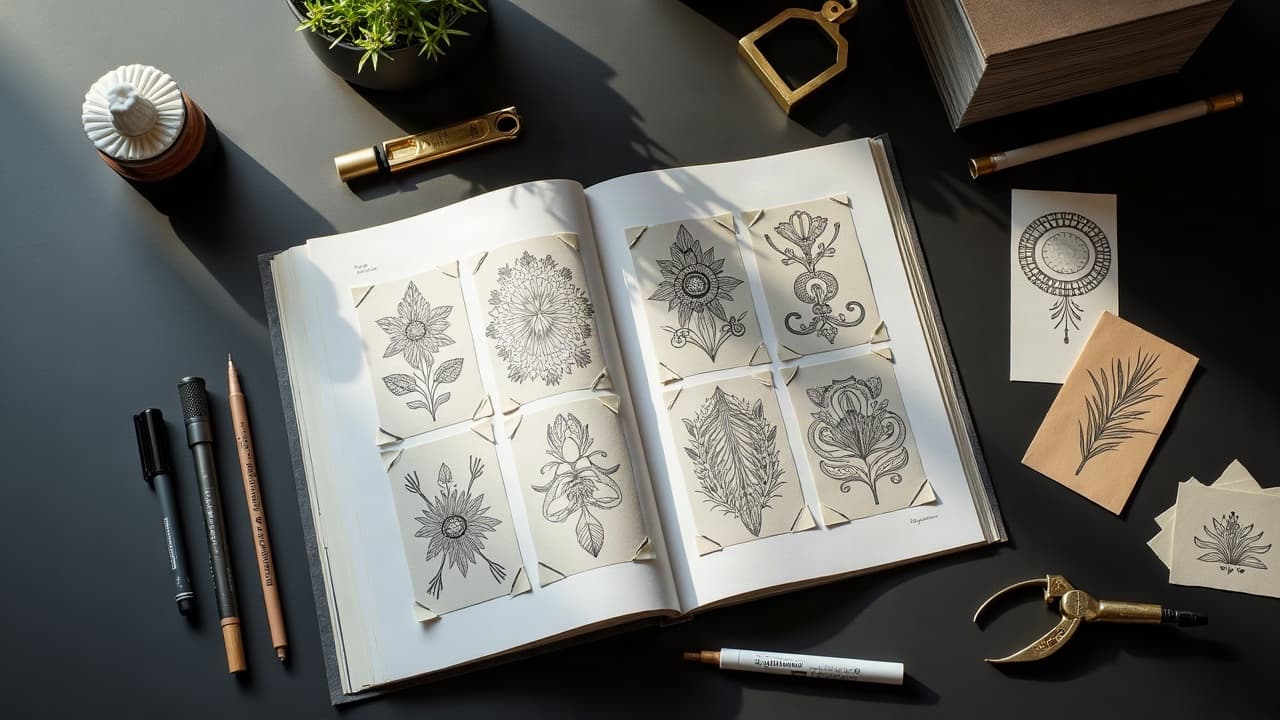
Pew Research Center estimates that roughly one-third of U.S. adults have at least one tattoo, and many have multiple. That scale means your options are wide, but the real win is alignment. When your artist’s instincts match your vision, you get cleaner decision-making, fewer redraws, and a piece that still looks like you five years later. This guide shows you how to read portfolios and conversations for stylistic fit, not just skill.
Set your visual lane before you shop
Before you evaluate an artist, tighten your brief. Gather 6-10 reference images and circle what you actually like in each. Label the attributes in plain language, for example fine line, black and grey, bold color blocking, negative space, loose sketch energy, micro-realism, neo traditional. This gives you a clear lane to compare against a studio’s body of work. Also define constraints up front: maximum budget, deadline, placement, size range, and pain tolerance. That way, you filter by feasibility, not just taste.
- Choose three core adjectives for your style lane, for example delicate, graphic, organic, to test against every portfolio image you save.
- Mark the must-have element, for example florals wrapping clockwise, specific birth flower, exact silhouette angle, so you can see if an artist nails that consistently.
- Set a working budget like $150–$250 per hour or day rate $800–$1,500, and note your upper cap before you inquire.
- Decide on size in inches and a healing window 10–21 days, so scheduling and aftercare are realistic for work or travel.
- Preview proportions on your body with a try-on tool before contacting artists to avoid major scale changes later.
Portfolio analysis that actually works
Scroll slower. You are not just asking if the tattoo looks cool today, you are asking if this artist repeats the exact qualities you want across skin types and body sites. Focus your portfolio analysis on technical consistency, readable design choices, and evidence of long-term thinking.
- Look for healed photos beside fresh ones. True alignment shows in healed saturation and line crispness, not just day-one shine.
- Zoom in on line weight. Is it stable on curves and over bony landmarks, or does it wobble when contour changes?
- Check black packing and saturation. Solid blacks should look velvety, not patchy. Color should appear even with no “holiday” gaps.
- Compare symmetry and flow across similar projects. In sleeves or spines, does the artist repeat good body flow mapping again and again?
- Scan for your subject matter. If you want wildflowers, you should see 10-plus great wildflowers by them, not just one lucky outlier.
- Evaluate negative space usage. Strong artists subtract as confidently as they add, leaving breathing room so details read at 3 feet.
Spot the artist’s signature techniques
Every strong artist has a default toolkit. If their signature moves are the ones you love, collaboration is smooth. If not, you will both be forcing it. Learn to name the techniques you are seeing so you can match to your brief.
- Single needle or micro liners for hair-thin outlines and tiny scripts, best for subtle detail but higher fade risk if overused on high-friction zones.
- Dotwork and stippling to build gradients with points, excellent for sacred geometry and soft shading without muddy blacks.
- Whip shading for powder-soft shadows, often in black and grey portraiture, watch for even whips and no peppery blowouts.
- Color realism with smooth blends and muted transitions, look for hue accuracy in skin tones and clean edges around highlights.
- Graphic traditional with bold 7–14 RL linework and simplified palettes for maximum readability from distance.
- Negative-space rendering where the skin is intentionally left bare to form highlights, powerful in botanicals and abstract geometry.
Healed results beat day-one shine
Fresh tattoos are swollen and glossy, so many look similar on day one. The truth shows at 3-6 months. Ask the studio for healed albums or captions that state “healed” and the timeline. Expect some softening, but not mush. The American Academy of Dermatology notes most tattoos surface-heal in about 2–4 weeks, with deeper settling continuing after that. See the AAD’s skin guidance at the American Academy of Dermatology.
- Prioritize artists who post healed photos of the exact style you want, same placement if possible.
- If blacks heal charcoal or lines spread, reconsider fine-line choices on that body site.
- Ask what aftercare the artist expects. Common products include Aquaphor, Bepanthen, Hustle Butter, Saniderm, Mad Rabbit (non-sponsored examples).
- Check for color staying power on your skin tone. Reds and yellows can shift. If your artist shows long-term examples, that is a green flag.
- Review healed texture in high-motion zones like elbows and ankles. Crispness there signals elite needle control.
Safety also shows up in healed work. The FDA regulates tattoo inks and has issued recalls and guidance when contamination risks appear. Read more at the U.S. Food and Drug Administration. For infection and allergic reaction basics, see the Cleveland Clinic for symptoms that warrant a check-in with a clinician.
Read the social presence for process and ethics
Captions and stories tell you how an artist thinks. Look for process posts that show stencils, freehand mapping, and healed check-ins. Consistency is your friend. An artist who repeats your favorite decision-making patterns will likely do it for you too. Professionalism in communication is part of style alignment as well, because you are signing up for a relationship that spans design, application, and touch-ups.
- Process transparency, for example stencil placement videos, freehand drawing reels, and healed side-by-sides.
- Clear policies in highlights for deposit 20–50%, rescheduling, and touch-ups within a stated window.
- Respectful caption tone, credit to references, and accurate labeling of healed vs fresh.
- Evidence of collaboration, for example sharing client-provided mockups and explaining how they translated them into tattooable forms.
- Reasonable waitlist 2–6 months for high-demand specialists. Ultra-short lists can be fine, but check depth of portfolio quality.
Consultation signals and pricing clarity
Your consult should reduce uncertainty. Strong alignment feels like “yes, and” collaboration, not a tug-of-war. The artist should restate your brief in their own words, sketch options that respect your non-negotiables, and explain tradeoffs in readability, aging, and placement flow. Expect clear estimates, for example $150–$250 per hour or day rate $800–$1,500, plus exact deposit terms and an expected session count.
- Green flags: they suggest minor changes to improve readability at 3 feet, not wholesale shifts that ignore your core idea.
- Green flags: they explain why certain line weights or needle groupings suit your skin and body site.
- Red flags: “I can do any style,” no healed photos, or unwillingness to discuss placement limits like ribs or feet.
- Red flags: vague pricing, no deposit policy, or pressure to book immediately despite an unclear design scope.
- Red flags: dismissing your cultural or symbolic boundaries rather than asking context and seeking accurate references.
If you need help translating your taste into tattooable direction, read our primer on composition flow in design balance and proportions. For clients with specific access needs, align expectations early using our consultation checklist for special requests.
Match style to skin tone, body site, and longevity
Stylistic alignment is inseparable from biology and anatomy. On deeper or richer skin tones, high-contrast black and grey or saturated primaries often read stronger than pastels. Ask to see healed work on clients with similar tones. Body site matters too. Fine-line scripts on inner fingers blur quickly. Heavy packing over stretch zones may crack or look cloudy. Healthline explains that blowouts happen when ink spreads below the intended layer, often from depth, angle, or high-motion sites. Read more at Healthline.
- Map movement. Areas that flex and rub, wrists, ankles, inner elbow, need bolder line weight and simpler shapes to age well.
- Use negative space for highlights on darker complexions rather than large white ink fills that can heal chalky or fade fast.
- Scale up small detail on calves, forearms, and thighs so micro elements remain legible after 3–5 years.
- For pain planning, expect pain 3–8/10 depending on placement. Schedule breaks and eat beforehand to stabilize energy.
Hygiene and safety underpin longevity. Baseline aftercare and infection risks are summarized well by the Cleveland Clinic. If you have a known pigment allergy or prior skin reactions, discuss patch testing or color choices. FDA advisories and recalls on inks and diluents appear at the U.S. Food and Drug Administration.
Do a low-risk test and prep collaborative references
If you are nearly there but not 100 percent sure, consider a small test piece with the same technique family you want in your larger work. That test gives you a healed read on their line crispness, saturation, and aftercare guidance on your body. For design collaboration, come prepared with annotated references that highlight shapes, spacing, and the parts you want to omit. This saves rounds of emails and reduces redraw fatigue for everyone.
- Mock up placements with a digital try-on so you can approve scale and angle before stencil day.
- Use concise annotations, for example “keep this petal silhouette, remove dot halo, 20 percent thicker lines.”
- Share 3 references that agree with each other and 1 that shows a boundary you do not want, to sharpen the guardrails.
- If you love hybrid looks, bring a tiered brief and preview variants using our prompt workshops for creative alignment.
For collaborative prep, see our guide to co-creating references in AI tattoo prompts for workshops and evolve ideas stepwise with prompt evolution guidelines. To browse styles fast, skim by category in styles. As a final thought, tattooing is a people business. Choose the person whose habits, not just highlights, match the way you want to work.
One more data point to keep scale in perspective. Popularity is not proof of fit. Pew Research Center confirms the mainstreaming of tattoos across demographics, but your project only needs one right artist. Find the person who draws naturally in your lane, and you will both do better work. Explore survey insights at the Pew Research Center.
Ready to test stylistic alignment before you book? Generate a custom concept with AI for Tattoo, adjust line weight and contrast, then preview it on your body using the virtual try-on. Share the link with your short list of artists to see who responds with the cleanest, most on-style plan. Start a concept in create or preview scale in try-on.
Try AI for Tattoo Free