
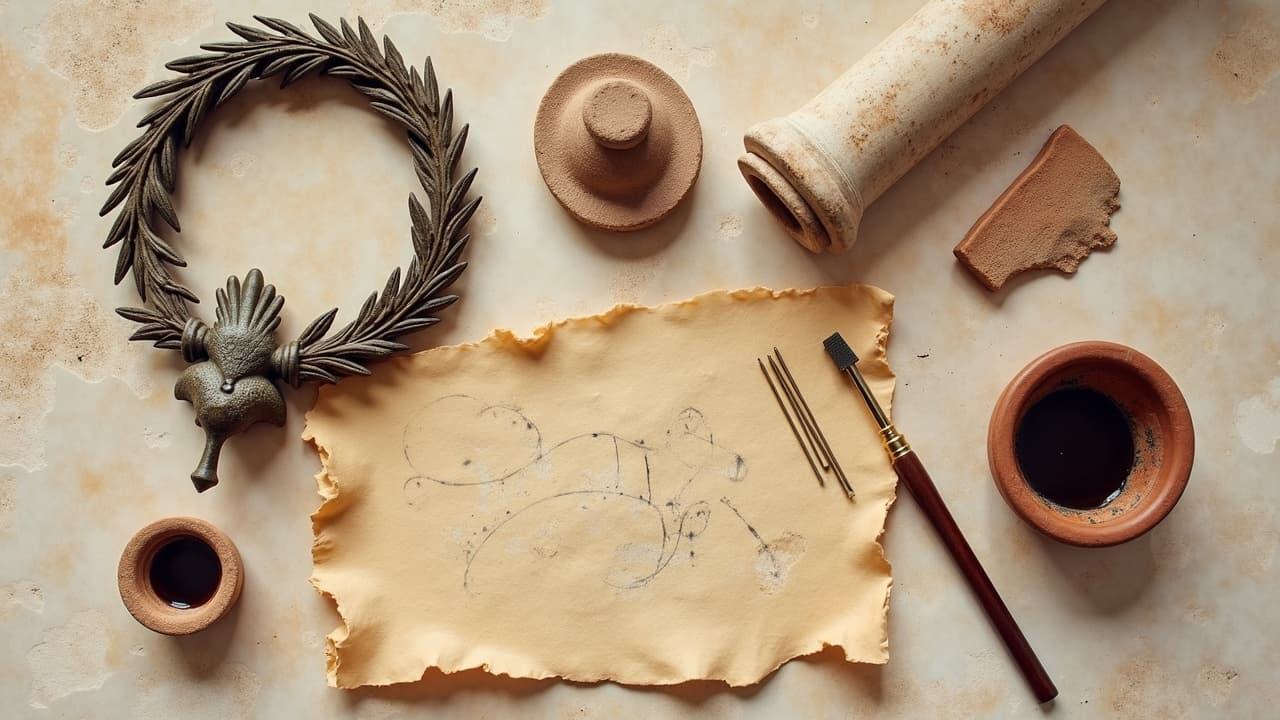
Roman authorities both tattooed people and outlawed certain tattoos. In late imperial law, branding the face was condemned, yet earlier sources reference soldiers marked with unit signs and enslaved people inked for identification. That tension shaped how Roman Empire tattoos functioned, and it still influences how we read these motifs on skin today. What survives is fragmentary, but when you line up military handbooks, legal texts, and museum evidence, a clear picture emerges.
Who in Rome Was Tattooed, and Why
In Roman Latin, tattooing and marking were often wrapped into the terms stigma or notae, marks. Soldiers are referenced as bearing identifying signs, usually interpreted as unit or imperial marks, a practical way to bind a recruit to a legion and prevent desertion. Enslaved people and convicted offenders could be forcibly marked for control or taxation. Later Christian emperors tried to curb face tattoos as degrading, which shows how visible placement was socially loaded.
- Military, unit or imperial identifiers, sometimes summarized as signa, used for loyalty and administration. Likely placed on accessible skin for inspection.
- Enslaved people, identification or fiscal notes, including owner information or tax status, typically in visible zones for monitoring.
- Punitive marks, tied to specific crimes or status, reinforcing stigma in the literal sense and policing movement within the empire.
- Religious or devotional marks, especially in late antiquity and beyond, with some pilgrims receiving Christian symbols near shrines.
When legal codes condemned facial markings, they did not end tattooing, they redirected it. Face markings dropped as policy while other placements persisted. This pivot is recorded in imperial law digests many cite through classical text libraries, a reminder that placement in Rome signaled hierarchy and punishment.
Tools and Inks in Antiquity
Ancient Mediterranean tattooing relied on simple puncture tools, bundled needles or sharpened awls, and carbon-based inks made from soot, ash, or lampblack mixed with binders. Branding and scarification also occurred, but true tattoo pigment deposition under the epidermis is attested by Greco-Roman authors who used verbs tied to pricking and staining. While we lack a surviving Roman tattoo kit in a glass case, comparative finds across the region and textual language point to techniques that would be familiar to any hand-poke artist today.
- Pigments, primarily black carbon, stable and still among the most lightfast tattoo colors today.
- Application, repeated puncture by hand, consistent with later hand-poke traditions rather than rotary or coil machines.
- Healing, slower under premodern hygiene, reinforcing why authorities discouraged wounds to the face that could disfigure.
For modern context on pigment safety and composition, see the U.S. FDA guidance on tattoo inks and colorants, which highlights contaminants and regulatory updates U.S. FDA on tattoo inks and pigments. Dermatology groups also track complications that would have been far riskier in pre-antibiotic Rome, see American Academy of Dermatology on tattoo complications and Cleveland Clinic guidance on tattoo infection risks.
Evidence We Can Actually Point To
Tattooing is hard to prove archaeologically because skin rarely survives, but the Roman world left a paper trail. Military manuals, legal codes, and Christian writers mention marks on soldiers, enslaved people, and penitents. In Roman Egypt, papyri discuss marked individuals in administrative contexts. Outside texts, artists depicted patterned bodies among foreign peoples on reliefs and coins, signaling difference rather than recording Roman tattoos directly.
- Texts, military and legal works copied through late antiquity, often accessed today via the Perseus Digital Library.
- Museum comparanda, objects and inscriptions contextualizing status and punishment, searchable in the British Museum collection.
- Scholarly syntheses, journal overviews on ancient tattoo practice and terminology, see JAMA Dermatology and classical studies at Cambridge University Press Journals.
A key pattern in the sources, Roman tattoos were never just decoration. They were administrative technology, like seals and passports. When modern artists adapt Roman motifs, that history informs what images say on skin.
Borders, Identities, and Cross‑Cultural Influence
Frontier zones, from Britain to the Danube and Syria, exposed Rome to peoples with strong body-marking traditions. Classical writers described Britons and Thracians with patterned skin, sometimes confusing tattoo and paint. Roman soldiers garrisoned in these regions would have seen and sometimes adopted local practices. That cross-talk complicates a simple picture of Roman-only motifs and helps explain why certain signs, like animals or gods, traveled across units and generations.
- Britannia and the north, classical reports of patterned bodies likely mix tattoo and pigment body paint.
- Danubian provinces, Thracian and Dacian markings referenced in Roman art and ethnography.
- Egypt and Syria, documentary papyri and Christian pilgrimage sites where devotional markings appear.
If you are researching culture-first approaches to ink, our long-form primer on non-Roman traditions pairs well with this topic, see tattoo rituals in African cultures. It helps frame how designs encode role, status, and belonging across societies.
What Roman Tattoos Meant Then
Meaning followed function. A unit sign was a loyalty mark and travel document. A slave mark signaled ownership, reinforcing surveillance. Punitive inscriptions attached offense to body, a portable sentence. By late antiquity, devotional marks tied skin to shrine, a counterclaim to the earlier stigma of punishment. Law codes that banned face tattoos, especially on condemned persons, acknowledged that the face was socially sacred, so harm there was a civic violation as much as a bodily one.
For modern readers, the key is that Roman marks were often legible to officials. Think of them as QR codes before QR codes, standardized and concise. That is why text bands, abbreviations like SPQR, legion numbers, and eagle emblems make sense in modern adaptations, particularly when tuned to context and placement.
Designing Respectful Roman‑Inspired Tattoos Today
Start by deciding whether you want to channel the administrative side or the mythic side. Administrative motifs, eagles, standards, wreaths with numerals, read like identity badges. Mythic motifs, Mars, Minerva, Victory, read as virtues and aspirations. Either way, combine iconography with Latin phrases sparingly. Too many banners will crowd a small forearm and blunt legibility, which mattered to Romans.
- Motif sets that work, Aquila plus laurel wreath and unit numeral, divine bust with attribute, column capital with SPQR ribbon.
- Style choices, stone-engraved line work, mosaic stipple, coin-profile shading, all play well in black and gray.
- Text strategy, limit to 2–3 words or a unit code. Romans favored abbreviations that read fast under poor light.
Placement matters. Upper arm or calf gives enough canvas for an eagle standard without warping around joints. Fingers and face are historically loaded in Roman law, so choose them deliberately. For more on matching motif to anatomy, see our body-shape design guide and the planning questions in first tattoo considerations.
Pain, Healing, and Longevity for Roman Motifs
Roman-inspired work is often line-dense with tight stipple, which can feel sharper than soft shading. Upper arm or outer calf usually lands around 3–5/10 pain for most clients. Ribcage and shin can jump to 7–9/10. Black carbon-heavy palettes age well, with 10+ year reads when aftercare is solid and sun is managed.
- Aftercare basics, fragrance-free wash, thin ointment layer, and breathable cover during the first 24–48 hours.
- Products that fit the brief, Saniderm, Aquaphor, Bepanthen, Hustle Butter, Mad Rabbit, TKTX for numbing when appropriate, use as directed (non-sponsored examples).
- Healing window, surface healing 7–14 days, full settling 4–6 weeks, black lines blur less if you minimize friction and sun.
For risk education and allergy realities, read our primer on pigments and reactions, tattoo allergy facts and prevention. For medical perspectives, consult the AAD and Cleveland Clinic, which outline infection signs, when to seek care, and why immunological responses sometimes flare months later American Academy of Dermatology on tattoo complications Cleveland Clinic guidance on tattoo infection risks.
Ethics and Context, SPQR Is Not a Blank Slate
Some Roman symbols, especially eagles and laurel-wreathed acronyms like SPQR, have been borrowed by extremist movements in recent decades. That does not erase classical meaning, but it does change how the mark reads in public. Add context in your design, for example a coin-portrait of Marcus Aurelius with a Stoic motto, to steer interpretation back to history and philosophy rather than modern politics.
- Prefer provenance, pair SPQR with a specific legion numeral and date range, 2nd century CE, to root it in history.
- Use material culture cues, mosaic borders, column capitals, and Latin lapidary fonts temper modern appropriation.
- Test the read, print a 1:1 stencil and ask three people what they see first. If the answer jars, adjust composition.
Research Workflow, From Sources to Sketch
You do not need a classics degree to ground a design. Start with museum search portals, then confirm terminology in a classical text library, and finally check a scholarly overview. Keep a running list of authentic spellings and abbreviations, for example IMP for imperator, COS for consul, TR P for tribunician power, if you are referencing coin legends.
- Browse authentic objects, reliefs, coins, and inscriptions in the British Museum collection.
- Confirm Latin terms and law references in the Perseus Digital Library.
- Skim peer-reviewed overviews via Cambridge University Press Journals and dermatology histories at JAMA Dermatology.
- Map the style, see how geometric borders interact with figures in our symbolic geometry guide.
From Antiquity to Your Skin, Test Before You Commit
Roman motifs demand clean hierarchy, primary symbol, secondary border, tertiary text. Draft three variants with different weight on each layer. If the eagle competes with the wreath, reduce leaf density or shift the numeral into a cartouche. Work in black and gray first, then audition muted reds for banners if needed.
Previewing scale is half the battle. Print full-size or use a high-fidelity virtual try-on. You will quickly see if 20–30 percent size adjustments unlock legibility across the biceps curve or the calf taper. Roman designs that sing on coin diameter can suffocate on a wrist if you do not edit.
Build a historically grounded Roman design and see it on your body before you book. Use AI for Tattoo to generate concepts with Latin abbreviations, eagles, and mosaic borders, then try them on at true scale to tune placement, size, and contrast.
Try AI for Tattoo Free